I looked at Luca, my voice dropping to a terrifying whisper. “So you drugged her?”
Silence slammed down over the foyer.
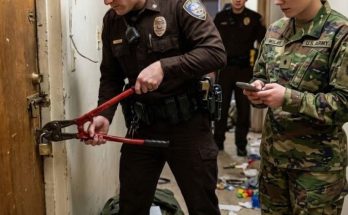
The sheriff’s deputy’s eyes narrowed instantly, his hand moving to rest on his belt.
Luca realized a second too late what he had just admitted out loud in front of law enforcement and protective services.
Wendy immediately took two steps back, throwing her hands up. “I had nothing to do with the medication! That was all him!”
Luca spun toward his wife, his eyes wide with betrayal. “Are you kidding me right now, Wendy?! You were the one spending the money!”
And just like that, they tore each other apart in front of six witnesses.
He blamed Wendy for the endless shopping and the boutique debts. She blamed him for forging the property deeds and firing the nurse. He shouted that she was the one who made Mom clean the floors on her knees. She screamed back that he had promised her I was never coming back from Asia.
I stood beside my mother, holding her small, trembling hand, and listened to them destroy themselves.
The sheriff served Luca with an emergency protection order and a notice of immediate removal from the premises. Adult Protective Services formally opened a criminal inquiry that very morning. Within a week, state prosecutors filed formal indictments for financial elder exploitation, grand larceny, forgery, and prescription fraud.
Wendy’s boutique collapsed within days when state auditors froze the accounts containing stolen funds. Luca’s employer terminated his executive contract the moment the felony indictment became public record.
But the real victory happened quietly, away from courtrooms and legal files.
Under Dr. Vance’s care, Mom was immediately detoxed from the heavy sedatives.
Three weeks later, she woke up from an afternoon nap in a sunlit bedroom, looked up at me sitting beside her bed, and said softly, “You know… you still hate red trucks, Jessi.”
I cried so hard I ended up laughing.
Six months later, Luca accepted a plea deal that carried mandatory financial restitution, three years in a state facility, and a permanent legal injunction barring him from ever accessing Mom’s assets or coming within five hundred feet of her. Wendy filed for divorce shortly after, only to discover she was personally liable for hundreds of thousands of dollars in spent, traced funds.
I sold the big house. Not because Luca had ruined it, but because my mother deserved a home that didn’t have a single dark memory embedded in the walls.
I bought a single-story home near the ocean—with wide picture windows, a sprawling rose garden, and no marble floors to scrub.
One quiet evening, as the tide rolled in, we sat together on the front porch drinking tea.
“I’m sorry I didn’t recognize you when you walked through the door that day,” Mom said softly, her hands resting peacefully in her lap.
I took her warm hand in mine. “You knew me, Mom. You just had to wait for me to clear the noise so you could remember.”
She leaned her head gently against my shoulder.
Inside the house, my phone buzzed on the kitchen table. Phoebe had sent a final confirmation that the restitution process was officially complete.
I didn’t bother to get up and check it.
The sun was sinking into the ocean, painting the sky in shades of gold and pink. For the first time in six years, nobody was asking me to fix their mess, and nobody was taking advantage of the people I loved.
I had already saved the only person who mattered.
EPILOGUE
A year after that quiet evening on the porch, our life had settled into a rhythm that felt entirely unbreakable.
The small coastal house smelled of sea salt, lavender, and the cinnamon pastries Mom had recently taken up baking again. Her mind had cleared completely once the chemical haze of the unauthorized sedatives was flushed from her system. Her hair had grown back thick and silver, her laughter had returned to fill the sunlit rooms, and the frightened, hollow shadow I had found on her knees was gone forever.
Every Tuesday morning, Dr. Arthur Vance stopped by for a routine check-in and tea on the porch. He confirmed what I already knew: my mother suffered from no degenerative cognitive disease whatsoever. What Luca and Wendy had labeled “dementia” was nothing more than systematic isolation, emotional abuse, and forced chemical sedation designed to render her compliant while they liquidated her life.
In court, the legal machinery concluded its work with cold, mechanical precision.
Luca began serving his sentence at a state correctional facility. With no income, no assets, and a felony record, his former lifestyle vanished entirely.
Wendy’s boutique was liquidated at auction to satisfy the civil restitution judgments. Forced to surrender her luxury cars, her designer wardrobe, and her high-society memberships, she moved into a modest apartment two towns over, working as a retail clerk to pay off her court-ordered debts.
I never visited either of them. I never answered their desperate letters. Some betrayals are so absolute that offering closure is simply an insult to the survivor.
One afternoon, Phoebe Vance drove down from the city to deliver the final accounting binders for the trust.
We sat at the wooden table in the garden while Mom showed Phoebe her newly blooming rosebushes.
“The trust assets have been fully restored, Jessi,” Phoebe said, setting a thin leather folder between our teacups. “The restitution funds from the liquidation of the boutique and the sports car lease have been re-invested into your mother’s long-term medical care account.”
I looked over at Mom, who was kneeling in the soil, wearing a bright yellow scarf and laughing as she showed the neighbor’s young daughter how to trim the stems.
“Thank you, Phoebe,” I said softly.
“You know,” Phoebe offered gently, looking at me, “most people in your position would have let anger dictate every step. You executed that recovery with terrifying precision.”
I smiled faintly, taking a sip of tea. “I didn’t do it out of anger, Phoebe. I did it because my mother spent thirty years building a shield around me when I was growing up. The second I saw someone tear that shield down, I realized it was my turn to build her a fortress.”
Later that evening, after Phoebe left and the sun began to dip beneath the horizon, Mom and I walked down the short wooden path that led from our backyard directly to the beach.
The cool Pacific breeze blew against our faces as we walked side by side along the hard-packed sand.
Mom stopped, looking out at the endless expanse of water, her silver hair catching the golden light of the dusk.
“Jessi?” she called out gently over the sound of the crashing waves.
“Yeah, Mom?”
“Did I ever tell you what your father said the day you were born?”
I looked at her, smiling. “No. What did he say?”
Mom turned to me, her eyes bright, clear, and fierce with love. “He held you in his arms, looked down at your tiny face, and said, ‘Rosa, this girl is going to be a force of nature. Nobody is ever going to push her around.’”
A tear traced its way down my cheek, but I was smiling. “He was right.”
Mom took my hand, locking her fingers tightly through mine. “He certainly was, sweetie. He certainly was.”
We stood together on the edge of the water, watching the darkness give way to a million bright stars above the ocean—completely safe, completely free, and finally, undeniably home.
THE END