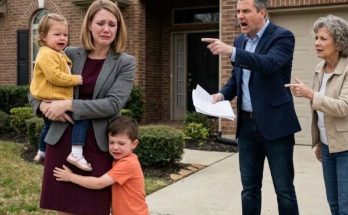
I watched Arthur Cole begin urgently whispering to his lead attorney.
Phoebe then called Selina to the stand. “Ms. Cole, can you swear under oath that every text message screenshot you submitted was generated directly from a live thread sent by Mr. Sterling?”
Selina hesitated, her eyes darting toward her father. “I… I received those messages.”
“That wasn’t my question,” Phoebe said firmly.
Her attorney objected, but the judge overruled, instructing the witness to answer.
“Can you produce the original live threads on your mobile device today?” Phoebe asked.
Selina looked down at her hands. “Some of the screenshots were compiled by family members assisting me.”
“Compiled?” Phoebe pressed. “Or edited?”
“I… I don’t recall.”
That single admission didn’t result in immediate criminal charges right there in the courtroom, but it completely shattered the credibility of the narrative she had maintained for months.
Then came the corporate accounting.
Howard’s forensic accountant presented the paper trail detailing the $150,000 initial investment and the subsequent routing of over $300,000 into entities tied to Arthur Cole and Selina.
Selina’s attorney frantically argued that the transfers were legitimate repayments for informal family loans.
The judge leaned forward over the bench. “Where are the loan agreements?”
Silence.
“Where are the promissory notes or corporate tax filings reflecting these loans?”
Nothing was produced.
The accountant then demonstrated that several large transfers had occurred after David had already been locked out of the company’s administrative systems. Selina changed her explanation twice on the stand under mild cross-examination.
Phoebe rested her hands on the podium. “Your Honor, we are not asking this court to adjudicate corporate embezzlement today. We are asking you to evaluate whether the severe restrictions placed on Mr. Sterling’s parental rights were based on truthful, reliable evidence.”
The judge called a twenty-minute recess.
David walked out into the hallway, leaning his back against the marble wall, taking deep, shaky breaths. “I’m terrified, Dad.”
“Of what?”
“That nothing changes. That she still wins.”
I understood his fear. For months, he had been conditioned to believe that an accusation alone was enough to destroy his life, regardless of the facts.
When court reconvened, the judge issued an immediate order modifying the custody arrangement. David was granted unsupervised visitation, expanding rapidly into overnight weekend stays.
There was no dramatic gavel slam or Hollywood arrest scene. But for the first time, the court formally recognized serious credibility issues regarding the evidence used against David.
David lowered his head into his hands and wept quietly. Not because he had ‘won,’ but because the legal system had finally stopped treating every unsubstantiated allegation against him as absolute truth.
EPILOGUE
The full legal resolution unfolded over the following year.
A court-appointed guardian ad litem interviewed teachers, pediatricians, therapists, and family members. Leo and Mason consistently expressed joy and comfort around their father, displaying zero fear.
Ultimately, the court established a balanced, joint-custody arrangement, with David securing primary physical custody during the school week due to his stable remote work schedule and home environment. Strict communication protocols were put in place to prevent Selina or her family from using the children as leverage.
The financial investigation proceeded through civil court. Facing forensic evidence of unauthorized transfers, Arthur Cole agreed to a substantial financial settlement to avoid a formal referral for corporate fraud, returning a significant portion of the drained capital.
David built a new, leaner software consultancy. This time, he instituted ironclad corporate governance: no single officer had unchecked access to operational funds, dual authorizations were required for major transfers, and every contract was reviewed by external legal counsel.
Nearly a year after I had found him living in that sedan, David and I sat in his sunlit living room. Leo and Mason were playing on the rug, loudly constructing an elaborate wooden block tower.
David looked out the window, holding a mug of coffee. “Dad.”
“Yeah?”
“I never properly thanked you.”
“You don’t need to thank your father for showing up.”
He shook his head. “If you hadn’t shown up that morning, I don’t know how long I would have stayed in that car. Selina and her family had convinced me that asking for help was proof that I was broken.”
He went quiet for a moment. “There were nights where I genuinely wondered if I was losing my mind. They kept repeating it—Selina, her mother, her lawyers. I started questioning my own memories.”
That was the deepest scar of the entire ordeal: they hadn’t just taken his house or his company; they had manipulated him into doubting his own sanity.
“I didn’t automatically assume you were blameless in everything, David,” I told him honestly. “You’re my son, not a saint. What I knew was that you deserved a fair review of the facts before being condemned.”
From the rug, Leo yelled, “Grandpa! Mason is cheating!”
“I am not cheating! It’s an engineering strategy!” Mason protested.
David let out a warm, genuine laugh—a sound entirely different from the hollow chuckle I had heard in that diner months ago.
I stood up from the couch. “Sounds like you boys need an impartial referee.”
I sat down on the floor beside them. The wooden tower was leaning dangerously to one side.
Leo held a block nervously. “Grandpa, don’t let it fall.”
For a brief second, my mind flashed back to that freezing morning in the parking lot—the fogged windows, the bags of clothes, David pushing open the car door with absolute shame written across his face.
I looked at my grandsons and smiled gently. “If it falls, boys,” I said, “we just build it again.”
Leo thought about it for a second, beamed, and pulled out a key support block.
The tower crashed across the rug in a dramatic cascade of wood. Both boys shrieked with laughter.
David stood in the doorway, watching us with a quiet, peaceful smile.
A year earlier, he had believed he had lost his home, his career, his dignity, and his sons. In reality, he had simply been trapped in a storm manufactured by people who mistook his patience for weakness.
I picked up one of the wooden blocks from the floor and tossed it gently to my son. “Your turn. Start building.”
David caught it, sat down beside us on the rug, and for the first time since I arrived in Chicago, looked at his life without a trace of shame—ready to build something that would last.
THE END