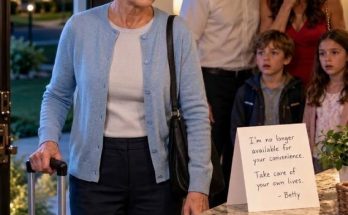
“Are you truly never coming back, Mom?”
“No.”
“Never?”
That single word carried a heavy weight, but my answer did not waver for a second.
“I will never live under your roof again, Stephanie.”
She gave a tiny, defeated nod.
“I do not even know how to begin fixing what I ruined.”
“Start by learning how to live your life without relying on another woman to run it for you,” I advised softly.
That night, sleeping in Clara’s quiet guest room, I slept nine full hours without waking up once.
The next few weeks passed with a strange, beautiful tranquility.
I did not magically get my stolen two hundred thousand dollars back, nor did I hire an expensive lawyer to wage an exhausting legal battle over it.
After carefully reviewing my situation, I accepted that proving financial elder abuse would be a long, painful struggle because I had willingly signed the bank transfers four years ago without putting strict legal conditions on paper.
I had to choose what was more important to recover at seventy two years old: my lost money or my remaining peace.
I chose my peace.
Meanwhile, without me lifting a single finger, Stephanie and Clinton’s fragile lifestyle began to crumble under its own weight.
Brenda called me a week later to give me an update while she was doing grocery shopping.
“Margaret, you would not believe the absolute chaos in that house right now,” Brenda laughed. “Getting the utilities reconnected took almost four whole days because Clinton went into the main office demanding elite VIP treatment and ended up in a screaming match with the desk clerk.”
“Did they manage to get things sorted out?” I asked.
“Eventually, but half the food in their fridge spoiled while the power was out, and they had to spend hundreds on emergency hotel rooms, late reconnect fees, and huge security deposits.”
That minor hassle was only the start of their downfall.
Clinton missed a vital digital project presentation during the internet blackout, causing his company to strip him of his quarterly performance bonus.
Their credit cards were completely maxed out, the massive mortgage on their expanded house was crushing them, and my pension money was no longer there to absorb their daily expenses.
Stephanie tried hiring a replacement housekeeper to handle the cooking and cleaning, but the first candidate quit after two chaotic days, and the second demanded a monthly wage that made Clinton turn pale.
Cooking three meals a day, doing endless laundry, ironing shirts, driving Mason to school, organizing groceries, taking care of the dog, and managing a large house was not just a little light help.
It was demanding, full time work, and they were finally learning exactly how much it cost.
One sunny Saturday afternoon, Stephanie called my phone, and I let it ring three times before picking up.
“Hello, Mom,” her voice sounded humbled and tired.
“Hello, Stephanie.”
“Can I bring Mason to see you at the town park tomorrow morning?”
“Yes, I would love that very much.”
We met by the large fountain in the center of the park.
When my sweet grandson spotted me sitting on a wooden bench, he let go of his mother’s hand and ran as fast as his little legs could carry him.
“Grandma!” he cheered, throwing his small arms around my neck.
I held him tight and wept softly into his hair.
It was the very first time I had cried since walking out of that supermarket, but these were not tears of anger or humiliation, they were tears of pure love.
“Why did you move away from our house, Grandma?” he asked innocently, looking up at me.
Stephanie looked at me nervously from a few feet away, holding her breath.
I had no intention of using a child as a weapon to hurt my daughter.
“Because Grandma needed to live in her very own small home, sweetheart,” I explained gently.
“Were you mad at me?”
“Never in my whole life, my sweet boy.”
I pulled the small yellow plastic dinosaur out of my coat pocket and placed it safely back into his small hand.
“I kept this safe for you the entire time.”
Mason beamed with joy and spent the next two hours running around the grass, eating vanilla ice cream, and telling me all about his third grade class.
Stephanie sat quietly on the bench beside us, barely saying a word.
Before we said our goodbyes, she reached into her purse and handed me a plain white envelope.
Inside was five hundred dollars in cash.
“It is not much compared to what we took, Mom,” she said softly, looking down at her hands. “But I am going to start paying you back every single month.”
I looked at the envelope, then at her.
“Do not make promises you cannot realistically keep, Stephanie.”
“It is not an empty promise,” she insisted quietly. “I got a real job working as an administrative assistant at a dental office starting Monday.”
Stephanie had finally stopped depending entirely on Clinton’s income to survive.
She had also gone through her closet and sold several designer handbags and luxury items that had been bought with my house money.
I did not shower her with praise, but I calmly accepted the envelope.
It was not a sign of instant forgiveness, but a small step toward her taking personal responsibility.
Our mother daughter relationship was never going to be the same as it was before, because some deep wounds heal into permanent scars that never truly vanish.
For the next few months, we only saw each other when she brought Mason to visit me on weekends.
I never stepped inside her front door again, I never cooked another meal for Clinton, I never paid a single one of their household bills, and I never ironed a dress shirt that did not belong to me.
And then, something wonderful happened that I had not anticipated.
My health began to improve dramatically.
I was sleeping peacefully through every night, and although the arthritis in my knees was still there, the constant aching pain grew significantly lighter.
My high blood pressure completely stabilized, I gained a healthy weight, and I began taking pleasant morning walks through the neighborhood park.
Clara took me to a local craft shop down the street, where I bought cheap, colorful yarn and started knitting again, a beloved hobby I had completely abandoned after Donald passed away.
One afternoon, Brenda stopped by Clara’s house to drink tea with us.
“I have some big news for you, Margaret,” Brenda said with a smile.
“What happened?”
“Stephanie and Clinton just put their big house up for sale on the market.”
The mounting debts were completely drowning them, and Clinton had accumulated even more financial liabilities trying to maintain his wealthy corporate image.
After weeks of explosive arguments over money, Stephanie had firmly demanded that they separate their bank accounts for good.
“The neighbors say you can hear them arguing all the way down the street,” Brenda added.
Sitting there with my cup of tea, I felt no joy or petty satisfaction at their downfall, which surprised me.
During those first painful weeks, I had imagined that watching them suffer consequences would bring me a sense of justice, but now that it was actually happening, I realized I did not need their suffering to feel whole again.
A month later, I found a lovely, small studio apartment located in the cozy backyard of a gentle elderly widow named Mrs. Higgins.
It was small and simple, featuring one bright bedroom, a small kitchenette with two stove burners, a clean bathroom, and a big window overlooking a garden full of potted flowers.
When Mrs. Higgins told me the monthly rent price, I almost laughed out loud with relief.
I could easily pay for it using just my monthly pension, with plenty of money left over for healthy groceries, my daily prescriptions, bus tickets, and the occasional ball of soft yarn.
I happily signed the lease agreement on the spot.
Mrs. Higgins handed me a single, shiny brass key.
I stood on the porch holding that key in the palm of my hand for a long time, letting the weight of it sink in.
Four years ago, I had foolishly given away my entire life savings because I was terrified of ending up lonely in my old age.
Now, I owned nothing more than a tiny studio room, yet for the very first time in years, I did not feel lonely at all.
I felt completely free.
I purchased a firm mattress, two ceramic plates, a small frying pan, a teapot, and a bright yellow mug.
Every single thing I owned in the world fit comfortably into the back of one yellow taxi cab, and I was genuinely happy.
By late January, I finished knitting a soft red sweater using yarn I had bought with my own pension money.
One rainy afternoon, as gray drops tapped against the window pane, I made myself a warm mug of chamomile tea and sat by the glass.
My old red leather wallet rested on the windowsill beside me, the exact same wallet I had pulled shut in front of Stephanie at the supermarket check-out line.
I no longer felt the urge to clutch it nervously against my chest to protect what little I had left.
I was no longer terrified that my money would run out before the end of the month, nor did I ever have to justify buying my essential medication, a bus ride, or a simple ball of yarn to anyone ever again.
Sitting in the quiet warmth of my room, I thought about Donald.
I remembered a piece of wisdom he had shared with me decades ago when Stephanie was just a teenager.
“We need to give our children strong wings to fly on their own, Margaret,” he had told me while sitting on our porch. “But never hand over your entire nest to them, because one day you might wake up and realize you have nowhere left to shelter yourself.”
For a long time, I believed my great mistake had been loving my daughter too much and helping her too often.
Now, looking back with a clear mind, I realized that helping her was never my mistake; my mistake was allowing my love to be used as a tool for emotional blackmail.
Being a mother does not mean funding the reckless lifestyle of grown children.
Being a grandmother does not mean turning yourself into an unpaid domestic servant.
Being seventy two years old does not mean your time and dignity are worth any less than anyone else’s.
Setting a firm boundary does not make a person selfish, sometimes, it is the only way to save your own life.
I took a warm sip from my yellow mug as the gentle rain continued to tap softly against the window glass.
In another life, at this exact hour, I would be bent over an ironing board pressing Clinton’s dress shirts, cooking dinner for ungrateful people, and worrying if I had enough money left to buy my blood pressure medication that month.
In this life, there was no one shouting demands at me from across the hallway.
There were no long lists of chores taped to the refrigerator door, and there were no unexpected charges draining my bank account.
It was just me, my hot chamomile tea, my cozy red sweater, a shiny key, and a front door that I could lock from the inside whenever I wanted.
I reached out and picked up my red wallet from the window ledge.
I ran my thumb gently over the cool metal clasp and snapped it shut with a firm grip.
Click.
I smiled softly to myself in the quiet room.
It had taken me seventy two long years to finally understand a fundamental truth: a mother can love her family with all her heart without ever surrendering her dignity, and sometimes, the most crucial door we ever open in our lives is the one we finally learn to close.
THE END.