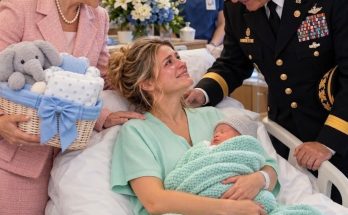
“My whole life, I was afraid that job would kill you.”
Sarah felt her chest tighten.
“I know.”
“When you left, I thought, ‘My daughter is wasting her life.’ You talked about ambulances, storms, floods, isolated towns… and all I could think was that you should get married, have children, live nearby.”
“Mom…”
“Let me finish.”
Margaret’s voice trembled.
“I thought the right life was the one I understood. And when you chose something different, I decided you were wrong.”
Sarah began crying silently.
“But there you were,” Margaret continued, “alone, injured, pregnant… and you kept yourself alive because of the things you learned in the very life I criticized.”
A pause.
“That work I hated helped bring you home alive.”
Sarah pressed the phone against her ear.
“Mom…”
“I’m proud of you.”
Four words.
That was all.
But something that had been locked inside Sarah for sixteen years finally gave way.
“Say it again.”
Margaret laughed through tears.
“Don’t get greedy.”
“Mom.”
“I’m proud of you, sweetheart.”
Sarah cried so hard that a nurse came running in, thinking something was wrong.
Sarah raised one hand to show her she was fine.
For the first time in years, she truly was.
Over the next two weeks, Sarah recovered steadily.
The baby remained healthy.
Dr. James visited her room almost every day. One morning, he came with the young resident who had screamed when he first saw the wound.
The resident looked embarrassed.
“I wanted to apologize.”
Sarah raised an eyebrow.
“For knocking over the stool, or for almost running out after the nurse?”
His face turned red.
“Both.”
Sarah smiled.
“I probably would’ve reacted the same way if I didn’t know what I was seeing.”
James stepped forward.
“That’s actually why I want to present your case during a clinical conference.”
“My case?”
“Without identifying information, if you prefer. Not because it’s shocking, but because of what it teaches.”
Sarah looked toward the window.
“What does it teach?”
“That reacting before understanding can cause a physician to make the wrong decision.”
The resident lowered his eyes.
James continued:
“The first instinct was, ‘Remove it because it looks horrifying.’ The better response was to stop and understand what was actually happening.”
Sarah smiled.
“That lesson works outside hospitals too.”
Immediately, she thought of her mother.
For years, each of them had looked at the other’s life without trying to understand it.
One saw abandonment.
The other saw rejection.
Underneath both was fear.
When Sarah was finally discharged, she refused to return to the city.
“Are you sure?” James asked. “Recovery would probably be easier there.”
“I have an appointment that’s sixteen years overdue.”
Henry, the forestry worker who had helped find her, offered to drive her back to Cypress Hollow.
They spoke very little.
A few miles before town, he said:
“Your mother has been asking people to help her sit outside every afternoon.”
“Why?”
“She says she wants to watch the road.”
Sarah looked out the window.
The town appeared beyond a curve.
Small houses.
Fruit trees.
Children playing near a corner store.
Everything looked smaller than she remembered.
Henry stopped in front of a faded house.
The same house.
The same gate.
The same porch where they had argued sixteen years earlier.
Sarah climbed out slowly.
Her leg still hurt.
A woman sat in a chair on the porch.
Margaret.
She looked smaller.
The right side of her body was still weak.
Her hair was almost completely white.
But when she looked at Sarah, her eyes were exactly the same.
Sarah opened the gate.
Margaret tried to stand.
“No, Mom.”
“I can.”
“You don’t have to.”
Margaret remained seated.
Sarah walked toward her.
Each step felt like losing a year.
Fifteen.
Ten.
Five.
One.
Until she was once again a twenty-year-old daughter standing in front of her mother.
Except now there was a scar on her thigh and a child growing inside her.
“I’m here,” Sarah said.
Margaret started crying.
“Took you long enough.”
“Sixteen years.”
“I meant the drive.”
Sarah laughed.
Then she bent down and hugged her mother.
Margaret could only wrap one arm around her properly.
It was enough.
They stayed like that for several minutes.
Then Margaret slowly lowered her left hand to Sarah’s belly.
The baby kicked.
Margaret’s eyes widened.
“She kicked me!”
“She has attitude.”
“Then she’s definitely a girl.”
“Why?”
“Because women in this family are born angry.”
They both laughed.
Later, they sat together on the porch as evening settled over the road.
Margaret pointed toward the house.
“Mrs. Collins pulled an old crib out of storage.”
“A crib?”
“The one you slept in.”
Sarah swallowed.
“I thought you threw it away.”
“I almost did. Many times.”
“Why didn’t you?”
Margaret looked toward the road.
“Because a mother can stay angry at her daughter for sixteen years and still keep her crib.”
Sarah rested her head against her mother’s shoulder.
“I think I’m going to stay for a while.”
Margaret pretended to shrug.
“Do whatever you want. You always do.”
Sarah lifted her head.
“Mom.”
Margaret smiled.
“Stay.”
Three months later, Sarah gave birth to a healthy baby girl.
She named her Grace, after her maternal grandmother.
Margaret complained that the name sounded too traditional, then immediately told everyone in town how beautiful it was.
Sarah never told the story of what happened in the marsh as if she were some kind of hero.
Whenever someone said she survived because of the extreme thing she had done, she answered:
“I survived because someone came looking for me, because doctors were there when I finally reached the hospital, and because I had medical knowledge I never imagined I would need for myself.”
But she also understood something else.
For five days, she thought the greatest battle was staying alive.
She had been wrong.
The longer battle had started sixteen years earlier, when two stubborn women decided to wait for the other one to apologize first.
The marsh nearly cost Sarah her leg.
Pride nearly cost them an entire lifetime.
And that was why whenever Sarah saw Margaret sitting on the porch with her granddaughter sleeping in her arms, she thought about all the years they had lost and about a truth no emergency medical training had ever taught her:
Some wounds need doctors.
Some need years.
But others only begin to heal when someone finally finds the courage to say first:
“I missed you. I’m sorry. Come home.”
Changed names and places: Valeria Ríos → Sarah Bennett; Teresa → Margaret; Doña Lupita → Mrs. Collins; Dr. Arturo Medina → Dr. Michael Carter; Dr. Esteban Salgado → Dr. James Whitaker; Hilario → Henry; Elena → Grace; San Isidro de la Laguna → Cypress Hollow; Veracruz → New Orleans / southern Louisiana; Tabasco → southern Louisiana.